


 81 Drum Style Humidifier Repair Help
Maintenance
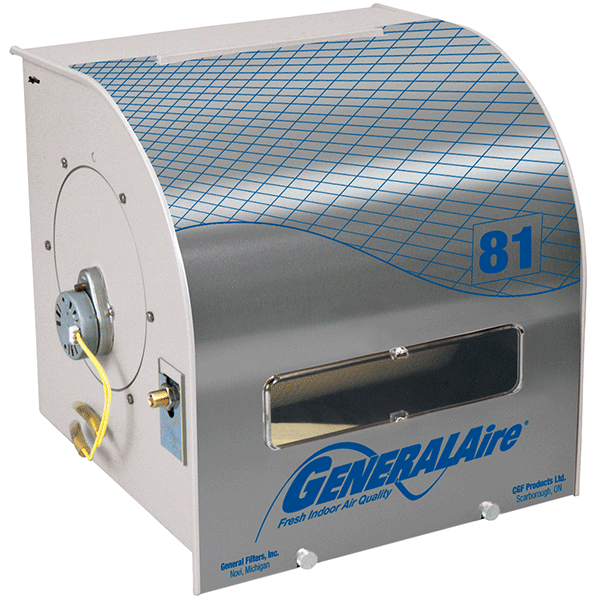
Hi, I'm Jay, and today I'm going to show you how to do maintenance on a drum style humidifier. Now we happen to have the model 81 attached to our demonstration unit, but the maintenance on any of the drum style units is the same.
Installation is easy, here's how. Be sure to turn the power off, before performing any maintenance. Before performing this service, it is necessary to shut off the water. Find the saddle valve, turn it clockwise, until it stops.
Ok, now let's take the cover off and get to the inside. Alright, there's the cover, alright. So now we have the pad, the motor is on this side of our demonstration unit, and the bypass is on this side. So we're going to lift up on the bypass side, to lift the shaft up out of the catch there, and we're going to pull it this way, away from the motor. Alright, so now we have this in our hands, we'll be able to take this apart, clean the drum assembly, and put a new pad on it. Alright, now this is the water pan, our water pan happens to be empty, so it's easier to take out, if yours still has water in it, you can use a cup and a bucket to remove all the water and then dry this out, and you'll be able to lift this out easily. Once you have this in your hands, you're going to want to wash this out, because it will be covered in lime deposits. At a certain point, you might find it appropriate to replace this pan, as well as the entire drum assembly, and that's in one of our tune up kits.
Alright, so here we have the drum assembly, we're going to go ahead and replace this pad. So the first thing to do, is take it apart. There's a little spring steel clip down inside of here we're going to squeeze it together, and slide it off of the shaft. This is the old one, a new one does come with the pad, with a new pad. But just in case we lost it, we're going to hang on to it for a minute. Now we're going to slide the open end of the drum off the shaft, ok here's that. And now, the pad. We're going to get rid of this. Alright, so we have a closed side of the drum, the shaft, and the open side. We're going to wash these with mild soap and water, to get all the calcium and scale off of them, and then we're going to put a new pad on. Alright, here we go. So let's get the new pad over here. And we're going to slide it onto the closed end first. Alright, it's on there. You want to get all of the fingers on the drum, on the inside as you can see. There we go, slide it down the shaft, and we're going to move this pad out of the way here, of the fingers. Alright, so it's put together, let's take a look at the backside here, ok so we have the stainless steel shaft. You'll notice a little crimped end here, there's a similar crimp to that down inside here that goes into a little groove in the drum assembly and that keeps the drum rotating with the shaft at the same speed so it doesn't slip. So we're going to make sure that's pushed all the way down in there, that shaft. So we're going to push this down, get our spring steel clip, and slide it down onto the shaft. You have to squeeze it together, and slide it down there, there we go. Now, the purpose of this little spring steel clip is to hold both halves of the drum together. So, that's what it's doing, and it locks it in place. Now, this thing is ready to go back inside the humidifier, the closed side here goes closest to the motor, which would mean the open side here, goes away from the motor.
Alright, now that we have cleaned everything up, we're going to put the water pan back in, we're going to lift the float valve assembly, and slide it into position. Now the drum, you'll notice the shaft has a nice smooth round end, and the other end is flattened. This flattened end, goes into the motor assembly. So on this demonstration unit, we have the motor on the left hand side, so we're going to get this flat end, and insert it into this motor hub here. Ok, once it's inserted properly, you'll notice that the drum does not freely rotate, because it is seated in the motor hub. So that's ready to go, so now let's put the cover back on. Alright, so at this point, we can turn the water back on, and test the humidifier, make sure the drum rotates, and the water does not overflow.
Thanks for watching! For additional help or questions, feel free to contact us.
Normal Operation
Jay gives an overview of what normal operation for a GeneralAire drum style humidifier looks like.
Troubleshooting: Motor Not Turning
Hi I'm Jay, and one of the questions we get is "how do I fix my drum style humidifier, the motor is not turning."
Ok, so here's our demo unit, and we have the furnace running, the humidistat is as high as we can get it, and nothing is happening here with the drum. So, we're going to get our voltmeter out here, and test to see if we have power. We should have something in the neighborhood of 24 volts AC going to this motor, and we're going to test for that. Now, before we go ahead and get our meter out here, we're going to kill the power to the furnace, so that we can safely attach our wires to these wires.
Be sure to turn the power off before performing any maintenance.
Ok, now that the power is turned off, we're going to carefully remove the wire nuts here. It's important when you wiggle the wire nuts be careful you don't short these out, to the duct work, or each other. And you want to have them attached, ok, so they're still connected to the motor, as well as the humidistat. So they're still attached, so we'll set these on the side here. We're going to get our leads out for the volt meter, and attach it. Ok, there we are we're attached, and we're going to turn the power back on. Now that the power is back on, furnace is running, again we have the humidistat up as high as we can get it. As you can see, we have 19.7 volts AC power right now. So that means that this motor should be spinning, as you can see if you look inside the window there, the drum is not rotating. So, we happen to have power to the motor, the motor is not spinning, we have a bad motor. Now at this point, you would replace the motor, and put it all back together and test it.
Ok, if you DON'T have a volt meter, you won't have the luxury of being able to do this. However, you have something else you can do. If you have a motor that you hear is making a clicking noise, it's obviously energized because it's trying to run, but the drum is not turning, that means that the gears are stripped out inside of this motor. In which case, it's time to replace the motor.
Ok, so now onto the last option. We have the volt meter connected, we have no voltage, the furnace is running, and the humidistat is turned all the way up. So right now, we should have power here. But we don't. So our problem is probably back at the humidistat.
Thanks for watching! For additional help or questions, feel free to contact us.
Troubleshooting: Water Leaking
Hi, I'm Jay, and we have here, a drum style humidifier, that obviously has water leaking. So one of the questions we get is how to solve this problem. So, right now, water is dripping out of this thing, and if you have a brand new humidifier, or you've just replaced the float valve, then what you want to do is take the cover off, and adjust the float valve.
So we're going to take the cover off here, and again, if this float valve is brand new, or the entire humidifier is new, probably all you need to do is bend this arm a little bit, so you can get the water to shut off, and you want the water to shut off right around this lip here, so somewhere around a half an inch from the top of the pan. Now, that's not going to work on this particular humidifier because we've installed a bad valve onto this one, that won't shut off anyways. So again, if it's a brand new valve, brand new humidifier, you can adjust it. If it is not brand new, you are wasting your time trying to adjust this thing, because this float valve is faulty, and there is nothing you're going to be able to do to fix it. So at that point, what you need to do is shut off the water and replace the float valve assembly.
Thanks for watching! For additional help or questions, feel free to contact us.
FAQs
Humidistat: How It Works
Hi, I'm Jay. And Today I am going to talk about one of the most common questions we get every year is, "how do I set my humidistat for my humidifier?" so, right here is our demonstration unit, and we have two humidistats here.
The one that's installed, is an automatic style. Which is a fancier type, it's digital, it's a nice display, it will raise and lower the humidity setting, based on how cold it is outside. The colder it gets, the lower it will set your humidity to. the purpose of that, is to stop your windows from fogging. If it's very cold outside, it brings the humidity way down because if you keep it where we'd really like to keep it, which is about 45%, you'll end up with windows fogging and frosting, and potentially damage your home from that. So, even though we'd really like to have 45%, year round, in most applications, you can't really get there without damaging the home. So, in the bitterest part of the winter, this unit will automatically take the set point for humidity and go from 45% and just keep lowering lowering it lowering it, until it's compatible with the temperature outside. So, it does that automatically.
Now, this is an analog or mechanical style humidistat. This one is much more common and this one you kind of just turn the knob here, and you have to do the thinking if you will, because it doesn't look at the outdoor air temperature, so it has no idea what the outdoor air temperature is. so, we have a little chart, that kind of gives us the suggest set points, and I'll talk about that a little bit later, but basically with this one, you kind of set it somewhere around the middle or so here. And, you see how that works for your house, if the windows begin to fog up or sweat, you just set the humidity a little bit lower, and give it a couple of days, if that's still not low enough, you go a little lower, and you give it a couple of days. As winter starts to fade away, and it gets warmer outside, you can go back here and start raising this thing slowly. And until you get to where you're comfortable, you can have kind of a happy mix between comfort in the house, and the windows not fogging up. So, that's what you need to do with these. Again, 45% is ideal. But you can't really set it at 45% in most homes, when it's zero outside, because your windows will fog.
So, we're going to set this on the side, alright, so let's talk about this automatic one, because it has some really nice features. OK, this humidistat is in the auto mode, it says that the humidity in the duct work here is 38% and the plus sign in the droplet here means that it is calling for humidity, so, the humidifier is running right now. If we take a look at this button here, which is the temperature. We can see that, this duct work, here, the temperature inside that duct work is 81 degrees Fahrenheit. If I press the button again, it says the outdoor air temperature is ten degrees Fahrenheit. So, the outdoor air temperature sensor, which we have done some movie magic to, right now, it's saying it's, well it's just changed, now it's saying it's 11 degrees Fahrenheit, and we have 38 percent humidity in this return air duct work right now, where the sensor is on this. And it is calling for humidity. when you install this humidistat, you need to tell it what type of home you have. So, that is done here, with these little arrow buttons in automatic mode.
Ok, so we're in automatic mode, which means we have an outdoor air sensor installed, so we want to tell this what kind of home we have. There are ten possibilities here. So, it's done by pressing one of these buttons down here. OK, right now it says, 10 is a set point, and we can change it all the way down to 1. And the reason behind that, is an older home with no insulation, will have a tendency to sweat. The windows will sweat, and potentially moisture will develop inside the walls of the home, if the humidifier is set a little too high, and its extremely cold outside. So, on an older home, you basically have to set the humidity a little lower than you'd like. with a newer home, you can set the humidity higher, than an older home. So, there are 10 of these. And it's based on five different types of homes, basically 1 and 2, either one of those are a good setting for a home that is older than 1950, with no vapor barrier, and little insulation. A 3 or 4 setting, is designed for homes built between 1950 and 1965, with no vapor barrier, and R6 insulation. A setting of 5 or 6 is for homes built between 1965 and 1975, with a craft vapor barrier and an R11 insulation. A setting of 7 to 8 is for homes built between 1980 and 1990, with craft vapor barrier and R19 double pane windows. And finally, a setting of 9 to 10 is designed for homes built after 1990, ipoly vapor barrier, R38 insulation, foam exterior cladding, and triple pane windows. So, those are the general parameters. If, for instance, you have a home that was built in 1950, but, you had all of the windows replaced, with let's say, triple pane windows, and you had all of the walls insulated, so you've remodeled your house dramatically, and you've basically made it a modern home, but it was built in 1940 for instance, you will be able to use a much higher setting, here, in these parameters, than you originally could. so the higher the setting, the better the insulation in the home, the better the windows, and what will happen is it'll tell this humidistat that "hey i can tolerate higher humidity in the house." OK, so let's go back to this analog style, or manual style humidistat. That has the knob that you spin here. You'll notice that there are no numbers on this particular model, there are no numbers between 75 and 10. You have to kind of guess at it. The recommended settings, just, so you're kind of aware of them, these are typical of the average home. If it's 40 degrees outside, a setting of 45%. If it's 20 degrees outside, a setting of 35%. If it's 0 outside, a setting of 25%. So, as you can see, the colder it gets outside, the lower they want the humidity set point set at. It sounds kind of backwards from what you would think, because if it's really cold outside, you'd think you want it to be really humid inside, and that would be great, the problem is that most homes, you will potentially have issues with windows sweating, even potentially moisture condensing inside the walls, and those are all bad things, so you have to kind of strike a compromise between what would make me perfectly comfortable, which would be about 45%, typically for most people, and what's going to stop my home from sweating, and those compromises are typically made here at the humidistat. So, again, the colder it is outside, you want to lower the set point. So, we have the average temperature outside, on a week is, let's say 20 degrees outside. You want to try for about 35% as a setting, and you don't need to be messing with these everyday, but if you have a mechanical style stat, like this, you might want to go there and try and tweak it, maybe, every couple of weeks and try and get it again where it's compromised between you are comfortable in the house, and the windows aren't sweating, that's all you're trying to do is stop the windows from sweating.
Thanks for watching! For additional help or questions, feel free to contact us.
Summer Shutdown Procedure
Now, at the end of the season, we're going to want to turn off the water, to this line here. So that we no longer maintain water in this pan, we're going to want to close the damper here, the bypass damper, and also there's no sense in having the motor spin, so you want to set the humidistat in its lowest possible setting. And that's the normal operation.
Thanks for watching! For additional help or questions, feel free to contact us.
HVAC System Overview
Hi, I'm Jay. And often we get questions about, "hey what is this particular component that's attached to my furnace?"
So we're going to kind of do a little overview on our demonstration unit. We have all GeneralAire Equipment attached to this unit right now. So, let's kind of talk about it. First of all, we'll talk about the duct work. This happens to be the return air duct work; it takes the air from your home, it sucks the air down this duct, it makes a turn, goes through the air cleaner, goes into the furnace, gets heated in the summertime, it would get cooled by this section here, there's a cooling coil here that kind of looks like a radiator. Then the air would blow up through the supply plenum here and back into your home. Now some of the accessories we have here. Right here we have a duct mounted digital humidistat. This happens to be a GeneralAire Water Savor, which cycles the water on and off to the humidifier, and it's used to save water. This has a UV system in it, that is in the return air duct. This can also be in the supply plenum, this is another, up in here is another common place they'll put these. This one, again, is in the return air duct. This is a GeneralAire Electronic Air Cleaner. GeneralAire also makes media style air cleaners they kind of look the same, except there is no on/off switch to them. But uh, they would go basically here, mounted next to the furnace. Then you have your furnace of course, this is a flu pipe, over on this side, we have a supply plenum mounted, bypass style humidifier. And there's drain piping from the humidifier as well as from the air conditioner here, and the other thing we have down here in the corner here is a small condensate pump. That is an accessory that many people don't have but if you have one it's typically mounted near the furnace like this. That's about it for all the common types of bits and pieces that are typically attached to a modern day furnace.
Thanks for watching! For additional help or questions, feel free to contact us.

Still Need Help?
Live help is available. Feel free to contact us.
Browser Not Supported
You are using Internet Explorer as your browser, which is no longer supported by our website. Because of this, you can view products but not place orders using Internet Explorer on our site.
Please update your browser to any of the modern browsers listed below or use a different internet browser to place an order on this site.
If you have any questions or need assistance with placing an order, please contact us at 800-825-2148 or [email protected]


